
Attention, Memorisation, Retention And The Guitar
When you’re trying to remember new information the brain tries to relate it to things you already know. If you pay very, very close attention to your thought process, sometimes you can even catch a glimpse of what’s going on behind the scenes. I occasionally get a flash of something distantly related to what I’m remembering. Sometimes it’s conscious but usually it all happens behind the curtain of the mind, so to speak. We can hijack this process to some extend by actively, consciously trying to think of things that are related to what we want to recall. In memory training circles people often talk about “hooks“. A “hook” is something we create in the mind on which to “hang” whatever we’re trying to remember. In other words if you’re trying to recall something complex you first need something simple and easy to remember. Then we can layer the more complex metal construct on top of it.
We can also use mnemonics to help us to remember things. A mnemonic is a visual picture to help the process of memorisation. They work best when they are utterly ridiculous, blown way out of proportion and exaggerated to the nth degree. Vivid colours. Imagined smells. Touch sensations. Noises. Use all the senses to bind the image to your memory. The really interesting thing is that eventually the mnemonic and/or “hook” disappear completely leaving you only with the information you wanted to recall, instantly available. Sounds good? Let’s give it a try.
Learning the names of the notes on the E strings is a good opportunity to use mnemonics. Seemingly a long string of unrelated fret locations and letter names. How about this: “F” is at the first fret.
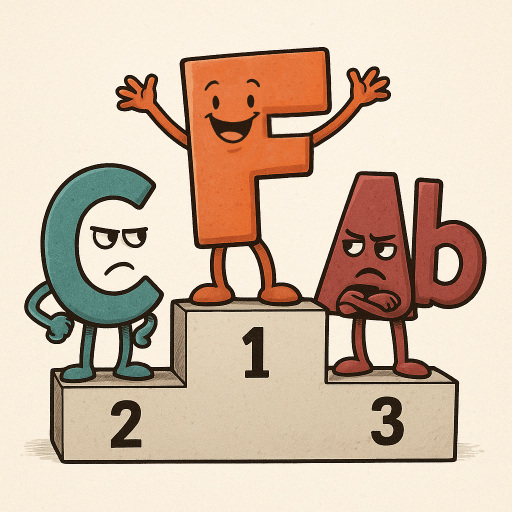
The game here is to be as creative as possible. Maybe you might think of something completely different and that’s absolutely OK! This is just a window into my own process. Moving on, the first thing I think of (and this is invariably the best place to start when it comes to creating mnemonics) when someone says “G3!” is “Goldilocks and the 3 bears”. Don’t ask me why, it just popped into my head. Other thoughts came shortly afterwards, like the G3 Tour with Joe Satriani, Steve Vai and Eric Johnson (which I attended back in the day) or the location G3 on a chessboard. The first one is the best. So I imagine a scenario and I try to make it as ridiculous and memorable as possible:

Don’t go questioning your thought process or second guessing yourself. There is no right or wrong… just whatever delights your brain cooks up in a flash. Then make it weirder. More vivid. 4th dimensional! I’ll give you the rest of my mental images for the E string along with the notes and locations. We also have A at the 5th fret (A5), B at the 7th fret (B7), C at the 8th fret (C8), D at the 10th fret (D10) and that’s it. When you hit the 12th fret we’re back to E again. See if you can work out the thought process behind the rest of these:


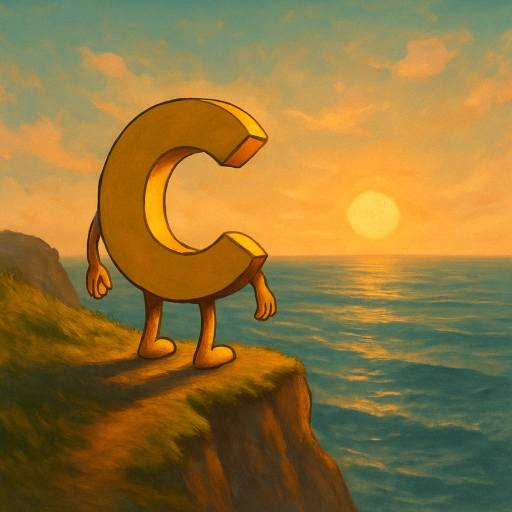

Alright, I admit the “C8” might have thrown you. When you stand on a cliff high above the sea it looks almost as if the sea (C) stretches out forever. The symbol for 8 also represents infinity. That’s how I arrived there! If you’d like to know more about memory training then I have talked about some notable practitioners in a previous blog post so please keep reading. Or alternatively you can google one of the following: Dominic System, PAO, Major System, Harry Lorayne, Dominic O’Brien.
Classical? Electric? Acoustic? Which one should I play?

So, you’d like to start having guitar lessons but you’re not sure what the best type of guitar is. I can assist you – but it may require a little reading first!
Guitar is a family that includes a huge number of instruments including the mandolin, the banjo, the ukelele, the guitarlele, the oud, the lute and the classical guitar as well as the flamenco guitar, the acoustic guitar, the dobro, lap steel (both types of slide guitar), bass guitar, 7 string acoustic, 12 string acoustic and still others. A bewildering array of instruments as I am sure you will agree. In all likelihood your decision as a beginner will come down to choosing between three. The classical, the electric and the acoustic. Simply put, the electric is made from a solid chunk of wood (although cheaper models are actually multiple bits of wood glued together) whereas classical and acoustic guitars are hollow. This usually makes electrics heavier as a result. One quick note worth mentioning: when guitarists talk about “acoustic” guitars they usually mean a guitar with metal strings and one which is built a bit differently from a “classical” guitar which has nylon (plastic) strings. When non-guitarists or beginners talk about “acoustic” guitars they don’t know the difference and could be talking about either. There is also the bass guitar which has thicker strings and is better suited to people with very thick fingers.
You could ask yourself what style of music you want to play. The instruments are all from the same family so it’s not impossible to play classical music on an electric guitar or electric guitar songs on a classical. It’s just that classical music sounds (arguably I suppose) the best on a classical instrument. If you want to play rock guitar then sure, you can do it on a classical but an electric would suit it better. If you like folky sounding finger-picking then you likely want an acoustic guitar. There are physical differences to the instruments too. Electric guitar is played using an amplifier which can make it as loud as you want – useful if you want to play with a band. Acoustic guitars sometimes come with a “pickup” – for now think of it as a type of miniature microphone – which lets you plug into an amplifier too, although they often don’t. It’s an option that you pay a bit more for. You can also install your own pickup if you don’t currently have one. HOWEVER – if you’re planning to do this then you ought to know that acoustic amplifiers are not the same as electric guitar amplifiers. If you plug an acoustic guitar into an electric amp or vice versa get ready for some truly hideous sounds. This brings me to my next point. As soon as electricity is involved we are suddenly dealing with pickups, amplifiers and the sculpting of the sound (equalization or EQ), not to mention distortion and effects (reverberation, echo/delay, flangers, phasers and on and on). Things can quickly get complicated. Electric guitars can sound very bad in the wrong hands… and often beginners can’t even hear that they sound bad because they don’t have the experience to tell a good or appropriate tone from a bad one. So for simplicity’s sake it might be best to start with a classical or acoustic guitar if you’re not sure.
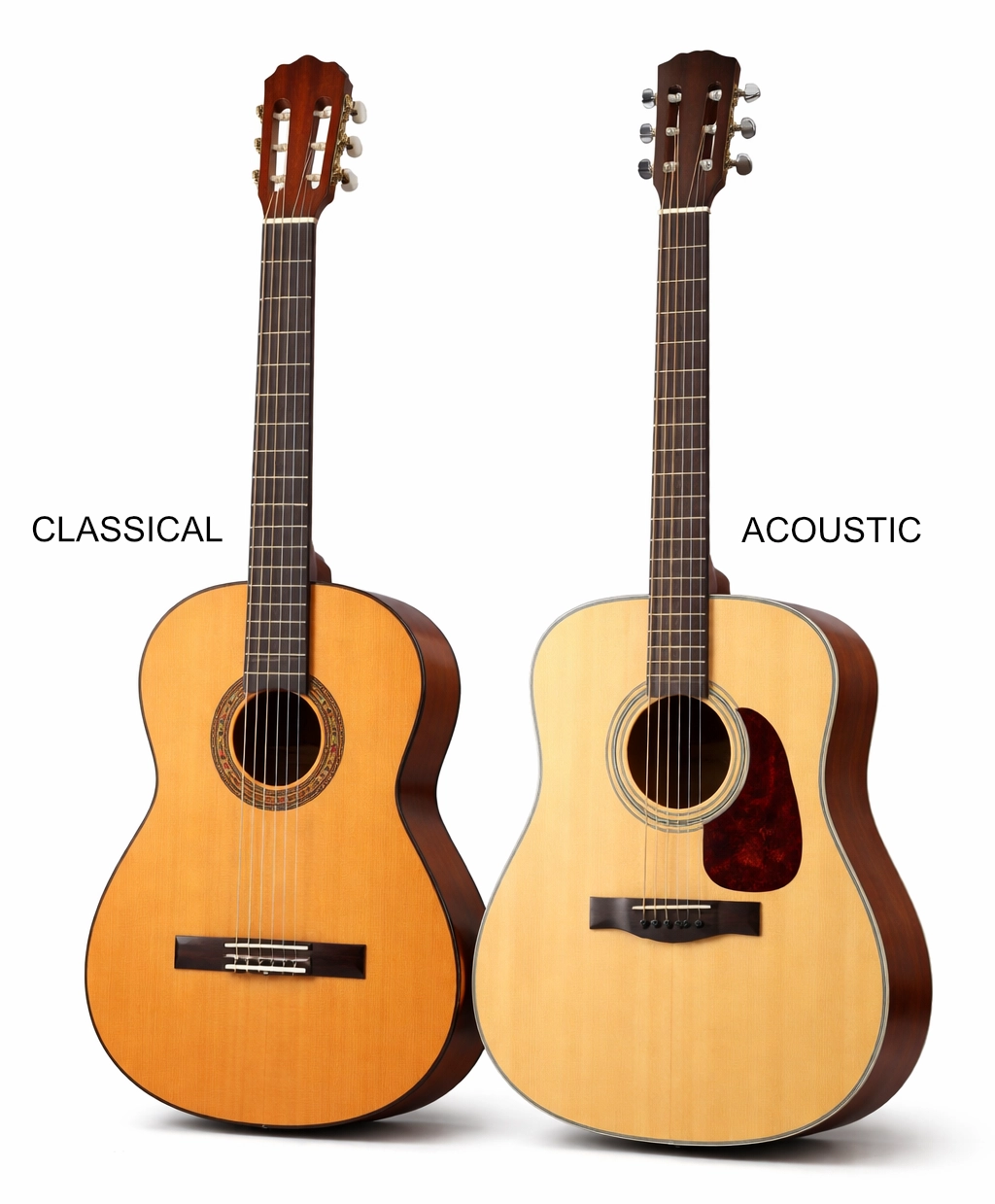
Classical guitars also have wider necks (better for those with bigger fingers) and this is because it makes it easier to avoid brushing against the wrong string when playing complex music. Classical guitarists also tend to be better at playing using all of their picking hand fingers and generally I would say that classical guitar is more demanding than any other style except perhaps jazz. An awareness of dynamics (loud and soft) is foisted upon the player right from the start with classical – whereas I know of many electric guitar players who play at the same volume pretty much all the time.
If you’re starting young (less than 18) then I would always suggest doing classical first. It’s a great base on which to build. You’ll learn to read sheet music (which has its own range of benefits), you’ll learn music theory and you’ll develop skills that are very transferrable to other types of guitar. Otherwise, if you know what music you love and want to emulate then go with whichever guitar you are drawn to. If in doubt, go with a classical guitar. That would be my advice. Acoustic guitars have metal strings which can be quite rough on the fingers if you’re not used to them. Just to confuse matters further some people who don’t know anything about guitars sometimes put electric guitar strings on a classical guitar which is an abomination! It sounds awful and feels awful – again, if you don’t know that it’s bad then you might think nothing of it.
Next question, which guitar to buy and where to buy it from? I would suggest going with a manufacturer like Yamaha, LAG, Admira, Cordoba. Classical guitars come in 3 sizes. Half size (for small children starting out, 3/4 size and full size. Adults should use full size unless vertically challenged. Electric guitars also come in two sizes (or perhaps more) but honestly, I would avoid anything other than a full size. Electric guitars that have shorter scale lengths (shorter necks) have problems with the strings being too loose and there’s really nothing much you can do about it. They sound bad. Full size is the only way to go in my view. The only reason short scale electric guitars exist is to fill the sales gap of small kids who desperately want to play electric guitar but are too small for a full size. In such cases it can work (because the kids don’t know what a good sounding electric is supposed to feel and sound like) but I don’t personally like them. Acoustic guitars come in travel size and full size. Travel size or “mini” acoustics can sound OK if you spend a bit more than the minimum. If an adult I always recommend full size.
So that’s it.
Singing and Playing Guitar Simultaneously

If that photo didn’t make you at least chuckle then I don’t know what to say. I’m sure one day AI will be so good that we’ll all look back on the days when it was awful in a nostalgic reverie. Anyway.
A really common question when I’m teaching the guitar is: “I want to be able to sing while I play the guitar“. The solution is manifold:
– You need to be able to play the guitar (!)
– You need to be able to sing (not that this has stopped anyone in the past!)
– You need to know the song so well on the guitar that you could have a conversation with someone while playing it and you won’t get anything wrong
– You need to know the lyrics and the song so well that you don’t stutter or pause for thought while singing it. It should be easy for you to sing it and within your range.
Once you’ve accomplished all of these basics – which might involve putting the song in a key suitable for your voice and/or using a capo – we can move onto the single biggest problem I see in guitar players. They have poor or very poor rhythmic awareness. Sometimes they have none at all! What does this mean?
Are you tapping your foot while you play? If you’re not, this is likely to be the problem.
Try tapping your foot in a steady rhythm and each time you tap count out loud “1, 2, 3, 4”. You can use a metronome to help with this, set it to about 60 or 70 beats per minute. You can clap as well at the same time you say “1, 2, 3, 4”. We call this “On The Beat“.
Now keep tapping your foot and every time the foot comes UP you must say the word “AND” (henceforth “+”). So you’ll say “+, +, +, +” over and over as your foot comes up. Remember it must go DOWN when the metronome clicks if you are using one. Now try clapping at the same time you say “+”. We call this “Off The Beat” or “The Offbeat“. It is also sometimes referred to as “Syncopation”.
Now let’s put the two together. As your foot goes down you count 1, 2, 3, 4 and as it comes up you say +, +, +, +. Put together that will sound like “1+2+3+4+” and your foot will be going “down, up, down, up” over and over. Once this is accomplished you can clap once for each thing you say. So you have to clap eight times in total, once each for the onbeat (1, 2, 3, 4) and once each for the four offbeat (+, +, +, +).
If any of this is difficult, great! Why great? If you are bad at something why are we celebrating? It’s because when you find something that you aren’t good at and it’s something as fundamental as rhythm, improving it is going to have a MASSIVE effect on your overall musical abilities. As you get better and better at music and the guitar it becomes harder and harder to get these same kind of gains.
If you want to train this ability further then you can start to apply it to the guitar. With your picking/strumming arm (the right arm if you are right handed) you can try to make a down motion with the pick for the 1, 2, 3, 4 and an up motion for the “+, +, +, +”. So now your arm is in tandem with your foot. It’s as if you were a puppet and a string was threaded through your hand and attached to your foot. When the foot goes down, the arm goes down. When the foot comes, up the arm comes up. This should take place constantly while you are strumming the chords to a song, even if you’re not actually strumming the guitar (the pick simply avoids the strings when you don’t want to hear a strum and lowers into them when you do want a strum). To begin with you might want to strum everything (i.e. 1 + 2 + 3 + 4 +).
Once you’ve mastered this we can try to figure out how to sing whatever song you want to sing and guess what? We will be tapping our foot while we do it. The most effective way to sing and play together as a beginner is to “quantise” or simplify the placement of the syllables of the song. For example suppose we want to sing “London Bridge Is Falling Down” and play chords at the same time. At the start of the phrase we have a slightly complex and fast rhythm for the “Lon-don” part. “Lon” is worth three quarters of a beat and “don” is worth one quarter, at least the way I learned it. We will simplify and make both parts into quavers. So tap your foot in the usual way and sing:
“Lon- (down) don (up) bridge (down) is (up) fall- (down) ing (up) down (down) (up)”
The last up motion of your foot doesn’t have a syllable and that’s fine. Once you’ve got this together try strumming a G chord in tandem with your foot.
More complex versions of strumming patterns can follow as can more complex syncopation of the rhythm of the lyrics. This is simply a baseline that must be achieved before you can jump into more complex music. As a final thought – please don’t be discouraged if this is difficult and please also don’t run away from it because you like to stick to things that make you feel accomplished. You have to head into the eye of the storm if you want to get better, so to speak. I hope this helps and if you need clarity on any of it leave a comment and I’ll get right back to you. Good luck!
I Can’t Remember Anything!

Ok. It’s time to admit it to yourself. You can’t remember things efficiently anymore. Maybe you never could. Probably you could, once… long ago. Back in school. You had people, teachers, parents breathing down your neck. You had peer pressure from your friends about who was going to go to which school/college next, who got the best grades, who was a dunce and so forth. Then maybe you went to university and got a degree and then ended up in a fairly static job. Fast forward 20 or 30 years and, like just about everyone, you spend a great deal of time on your phone/tablet and/or watch a lot of YouTube. You probably forgot that when you were in school you were reading books all the time. As Tyrion Lannister, played by the great Peter Dinklage in Game Of Thrones, said “A mind needs books like a sword needs a whetstone if it is to keep its edge”. Of course, it’s actually George R.R. Martin that we should thank for that nugget of wisdom. It contains a deep truth.
If you want your brain to work better, you could start reading books again. Or if you insist on binge watching shows on Netflix, how about pausing them to make sure you’ve really got a grasp of the plot and the character names? Watching shows and barely grasping what’s happening and being OK with that is symptomatic of cognitive decline, in my opinion. If you’re anything like me your brain has turned to mush through LACK OF PAYING PROPER ATTENTION. This is a real killer for memory retention. If you want to master the guitar, or anything complex for that matter, get ready for a whole lot of information coming at you! Scales, intervals, arpeggios, chords, inversions, voice leading, arranging and on and on. There’s a lot of it and we want to be sure that by the time we get to the end of it we haven’t forgotten what we started with.
“Use it or lose it” tends to be the memory mantra. No matter how well you know something, if you leave it too long it fades. It’s a simple and unfortunate fact of life. Also, to really be able to use something we must be familiar with it. Translation: we have to know it well enough that it’s instantly available. In music if you have to stop and think about something before you use it then 9 times out of 10 the moment or the inspiration is lost.
One of the things I think that makes memorising things easier is context. If you’re trying to remember the chord of C on the guitar, for example, you could start by drawing a picture of the guitar (six vertical lines and four horizontal ones – a “fretbox” as it’s known) and draw the circles for where your fingers are supposed to go. You could repeat this with the letter names of the notes that would be found at those locations. You could also repeat this with the number of which finger is supposed to play at that fret. You could write the chord in “tab” format. You could write the chord in musical notation, provided of course that you know how to write musical notation (writing C isn’t too hard, you could look it up). You could close your eyes and visualise the fretting hand. You could try to feel the feeling of the correct fingers in the right positions. You could try to make the chord shape without looking and then check to see if you got it right. All of these methods will coalesce into a really strong memory of the chord.
Another thing that I think really determines how well your memory works when it comes to the guitar is simply how interested you are. If you’re not particularly interested, good luck learning anything! I feel like this was school in a nutshell. Who can memorise the largest amount of pointless facts? That was the order of the day. However in this case you should (the “S” word) be interested. So are you?
If you want to push yourself further down this whole memory business then you could also investigate memory training methods. Learn about the Dominic System (after Dominic O’Brian, one of the true masters of memory) or the Major System, Harry Lorayne, Person/Action/Object (PAO) and try to find a way to apply it to music. For me the whole mnemonic system really helps when it comes to understanding how my brain works and I have spent considerable time applying these techniques to scores. Maybe you too should do the same?
Help me, Guitar Doctor. I Can’t Play F!

So, you are trying to learn to play the guitar and you can’t play the F chord. The F CHORD! The bane of so many aspiring guitarists. Well, I have news for you. You’re not the only one! In fact the number of adult guitar students who never get past the F chord are legion. The good news is that you punched this into Google or some search engine and (hopefully) you ended up here. It’s good news because I can help you. I’ve been there.
Before we can fix the problem we have to identify the possible causes. There are a few.
Believe it or not, the number one cause? A bad guitar. Not bad because it’s the wrong guitar for you (although that might possibly be the case) but bad because it hasn’t been properly “SET UP”. If this is a new concept to you then please allow me to enlighten you. Guitars are manufactured often in countries like Indonesia, China, Korea, Mexico and so on, often with very high humidity and a completely different ambient temperature range to their (your) final destination. When they make the guitar all is well – we hope – and the guitar is duly packaged in a cardboard box and eventually put onto a shipping container. 3 months later, or whatever it is, it arrives in its destination country. How was the temperature on the container ship? Could be freezing. Could be extremely warm or even hot if it’s placed near the ship’s engines. Then the guitar sits in a possibly freezing, possibly boiling packaging depot for an unknown period of time – weeks? months? -followed by the seller’s warehouse for an unknown period of time. So what? Here’s the thing. Guitars are made out of wood and metal. When wood is exposed to humidity it expands, a bit like a wooden door that starts to stick in winter. When the humidity is low, as it often is when your central heating is on, guitars dry out. Similarly, metal shrinks as it gets cold and expands as it warms. Hidden right in the middle of the neck of your guitar is a steel “truss rod” which is very much affected by temperature. All of this can mean that by the time the guitar ends up in your hands the vast number of environments the guitar has spent time in can have really messed up the playability. An easy to play guitar will have not too great a distance between the fingerboard (the long part) and the strings. This is known as the “action” of the guitar. Now, I’ve seen guitars from cheap manufacturers with an action so high that playing it for more than two songs would result in an injury and that is not hyperbole. It’s not even a rarity, it’s as common as a garden snail. So you can’t play an F because… <drumroll please> … your guitar needs to be taken to a guitar repair person known as a luthier. The luthier can adjust the truss rod, the height of the bridge, the height of the nut, the nut grooves, the saddles, the frets themselves and so on. It’s not something you should try to do yourself unless you’re into woodworking or enjoy a challenge. The luthier does the job (last I heard it was about £80 – £90 for this service which may in fact be more than the cost of the guitar. Should you be concerned? I guess if you’re buying a guitar then buying it from a shop which does a set-up on all their guitars as standard is a good bet. This, by the way, is a good reason not to buy a guitar online. Yes it may be cheaper but unless you’re running a big risk of the guitar being unplayable or being shipped B stock. In fact this exact circumstance happened to a friend of mine. We both bought guitars from one of the UK’s biggest and most prestigious companies. Mine came from the showroom and was perfect – he bought the same model online and ended up with one with a defect and he had to return it. They didn’t make the return particularly smooth, either! Although to be fair to them they did eventually take it back.
Ok so your guitar is now back from the luthier and it plays like a dream. However, you still can’t play an F chord. Let’s move onto the next possible reason: Your hands are cold! A friend of mine was a professional guitarist and gave me this tip many years ago. If your hands are freezing and you have to play a gig, go to the bathroom of the venue and run your fingers under the hot tap… as hot as you can stand it for as long as you can stand it. Obviously don’t do yourself an injury or burn yourself – be sensible. Alternatively you can vigorously rub your hands together. Make a fist with one hand and rub the front part of the fingers with the other hand and then repeat this for the other side. Give a few very hard claps of the hands and then rub them together hard. I’ve heard many stories of guitarists who – when they want to play their best – sit in a small room and crank the heating or put a radiator on full. The warmer your hands/joints/muscles the easier it becomes. That’s why people often play their best on stage when the lights are cooking and they’re boiling hot and sweaty. Everything loosens up.
On to the next reason: Finger flexibility! If you haven’t been using your fingers for anything particularly dexterous for the last 10, 20 or 30 years (or longer, who knows) then asking your fingers to play an F chord can be like joining an advanced yoga class when you haven’t touched your toes in living memory. It’s not going to end well! Guitar is a lot like finger gymnastics or yoga. If you try to do something that’s beyond your flexibility you end up either in pain or with a serious injury. Again, I know this from experience. If you experience pain when playing, STOP IMMEDIATELY. Even just a few moments of doing something with pain can leave you with a problem that can go on and on for months. Playing should be pain free. A bit of a warm sensation from using your muscles is fine. Sharp pain is not fine. So how can we fix bad finger flexibility? Let’s start with the “Finger Yoga”. Begin by placing your hands together with your fingers splayed apart. Cross your thumbs so that the right hand thumb is touching the left hand where the first knuckle is and the left hand thumb touches the first knuckle of the right hand thumb. Now bring them back up and cross them over the other side. Then bring them back to the starting position opposite one-another. Now repeat this for each set of fingers in turn. Only one pair of fingers should move at a time, all the others should stay in the starting position. You may find that when you reach the ring finger and the little finger it becomes very difficult to move just one finger. If you struggle, just move the fingers as much as you can. They don’t have to go all the way down. Once you reach the little finger then you can come back to the ring, middle, index and finally repeat the whole exercise again over and over. Aim eventually to go all the way down with each set of fingers and to go as quickly as is possible. This exercise is great for a warm up.

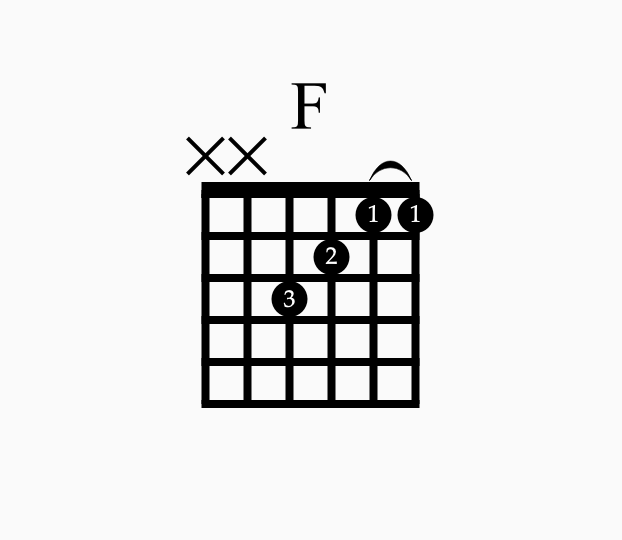
So your guitar is now playable! Your fingers are warm! You’ve been doing finger yoga every day for a month (don’t think it’s magically going to fix your arthritic stubs in one session, this is something to do every single day and even twice a day if you really have poor flexibility) and you STILL can’t play an F chord. It’s possible that you’re trying to do the big size chord and it’s a little too hard for you. There is in fact an easier way, although it doesn’t sound as good or full as the big F chord. Enter the small F chord. You don’t need to play all the strings, just the top four. This can be a good stepping stone on the way to playing the full F. See the diagram below. You will need to be careful which strings to strum here – don’t hit the lowest two strings (E and A). Strum only from the D string downwards. Use the flat part of your first finger to cover the first fret of the first two strings:
If this is still too hard then you can try an even smaller version of F that only uses three strings. Think of this as a stepping stone to the bigger version:
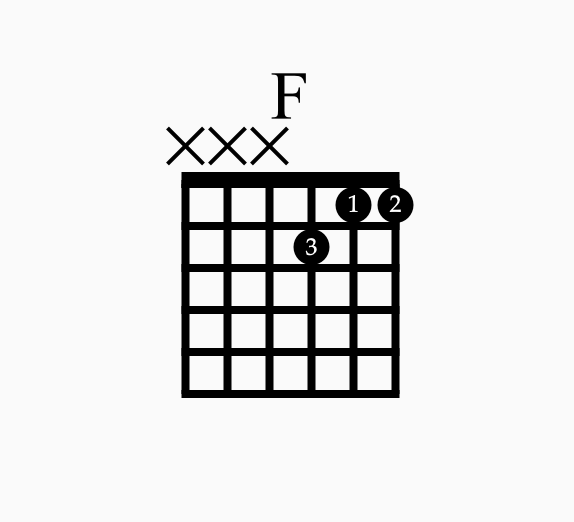
Still too hard? No problem. I’ve had many a student who couldn’t do two strings with the first finger, although sometimes the position of your fretting hand thumb and/or general posture can need adjustment. Try it using your third finger where your second finger is and your second finger on the first string. Or whatever fingering works for you!
Let’s suppose you still can’t do it despite everything we’ve done so far. Don’t give up. May I recommend coming to see me for a lesson? Guitar is a journey with a different beginning and ending for everyone. It’s not about the destination so much as the sight-seeing along the way. If your fingers are too large and they’re getting in the way of each other then you might be playing the wrong kind of guitar. A classical style guitar works better for those with very thick fingers… or there’s always the bass! I wish you the best of luck in your quest… and remember, after F there’s always B minor to contend with! That’ll have to wait for another day though. Until then!