
A Challenge For The ‘Serious’ Player
The guitar poses unique problems to solve. The nature of stringed instruments is such that we can sometimes play the same note in two places. To add to the confusion, the guitar has a very long neck. This means that there may be as many as 5 different ways to play the same note. Then there is the fact that the guitar is not tuned symmetrically (at least in standard tuning). The long and short of it is that if I take a 3 note ascending sequence, say C, D, E and then go through all the possible permutations of how the notes can be played I end up with a massive number of different ways of playing the same notes – with the same pitches! This is madness. How are we to gain mastery when everything we can play has so many variants? It’s a problem that becomes clearer to guitarists the longer we play and the more seriously we take it.
A very well renowned jazz teacher I saw for lessons once articulated this problem well and suggested taking groups such as these and regularly playing them in every position on the guitar. In other words there is no way around it – the only way is to master playing every possible permutation. This is if you want to have the ultimate control over the instrument. Most intermediate to advanced players will not need this kind of mastery even to play well. What most people do on guitar is learn a bunch of things and then re-order them. In other words more like choreography than true improvisation.
If, however, we are striving for total control, it makes sense to figure out what the most common short melodic sequences are and then spend a bit of time making sure that there are no black spots for us on the fretboard. Maybe one could begin with something like what you see below. Have a play through if you are on the electric or acoustic… classical will be a bit more of a challenge although the same principals apply:
 Guitar. A serious business. Seriously.
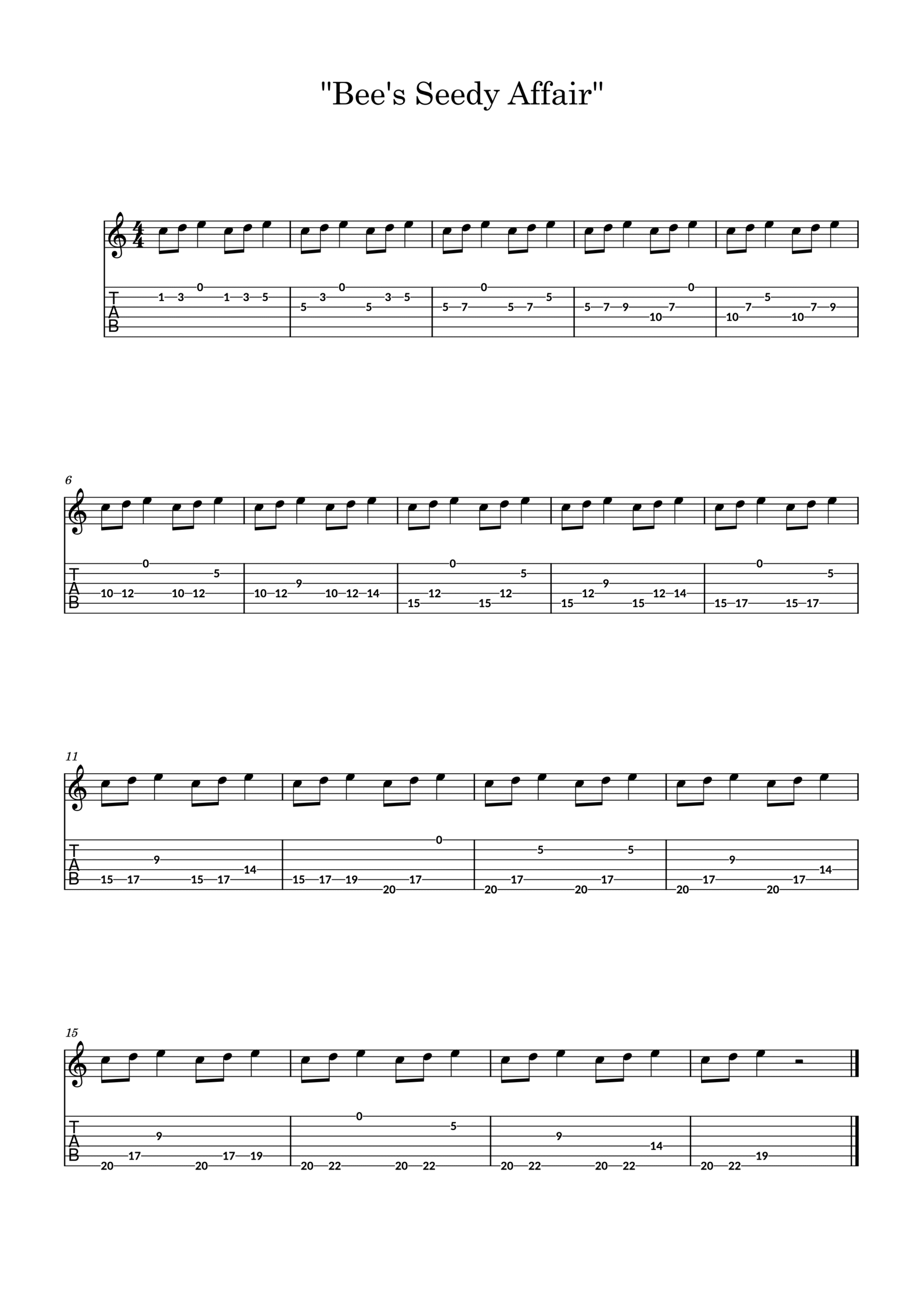
You can see why I had to include the tablature here – from a note reading perspective it all looks the same but clearly it’s very different. My engraving software wouldn’t let me write the final combination on the low E string as it doesn’t understand 24 fret guitars. Or maybe it just thinks no-one would be stupid enough to try to play the 24th fret of the low E. It was wrong! This is a rather staggering 36 different ways to play one small, three note sequence. Actually there are still more as I left out at least another 12 because they’re even harder to play. How many small sequences are there? Probably hundreds. 48 variants multiplied by hundreds of sequences… get me a piano! I’m done with this madness! Whoops, did I say that out loud? I must have forgotten to take my medication today.
Actually it’s not quite as bad as you may think because there are a limited number of building blocks (interval shapes) and they will be reused across all the different sequences. Also you could and should throw out some of these – let’s say the ones where you have to jump across multiple strings – because they’re not likely to come be useful. There’s nothing wrong with being aware of them… it’s just that the guitar is a fairly good approximation of infinity, at least as far as we mortals are concerned. You can’t learn everything and trying to do so can result in guitarist-syndrome. You know, the super long hair, unwashed clothes, zero social skills, living in your parents’ basement and so on. I’m not disparaging the benefits of 30 years living in a cave with a guitar. I’m just saying that being a musician is like being a top trumps card. You have various statistics – health, vitality, dexterity, theory knowledge, aural skills, charm and so forth. Having one of these stats at 10 while the others are at 2 will not a successful career make. The world is full of bedroom shredders/guitar nerds that no-one hears or cares about. So rather than trying to learn everything, when it comes to the guitar it is important to know what not to learn.
A quote comes to mind. “There are two mistakes when it comes to mastery: not starting and not going all the way“.
Hopefully you are now starting to see rather a lot of work in front of you. Do you need me to spell it all out? I hope not… because if you do then you haven’t quite “got it” yet.
Until the next time!